
Timber Rattlesnake
Crotalus horridus

Size
48–72 in
Status
Endangered
Venomous
Yes
Region
South-central IN
Indiana's largest venomous snake, now restricted to the rugged forests of the south-central hills. Shy, well-camouflaged, and state endangered.
Identification
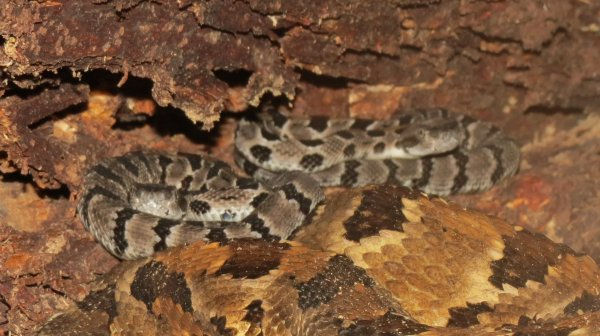
A heavy-bodied snake with dark chevron or V-shaped crossbands on a yellow, tan, or gray body, often with a rust-colored dorsal stripe, ending in a black tail and a rattle. It has a broad, triangular head and vertical pupils. Adults commonly reach 4–5 feet.
Habitat & Diet
Inhabits forested hillsides, rocky ravines, and ridgetops, especially around Brown County and adjacent counties. It ambushes rodents and other small mammals, playing an important role in controlling them.
Conservation in Indiana
Listed as State Endangered, with only a few small populations remaining after decades of habitat loss and persecution. It is protected by law; give any timber rattlesnake plenty of space and never handle it.
Similar Species & Taxonomy
In Indiana the only similar snake is the smaller Eastern Massasauga, which has rounded dorsal blotches and nine large plates on the crown; the Timber Rattlesnake is larger, with dark V-shaped crossbands and small scales covering the head. Both are venomous and should never be handled. A large pit viper (family Viperidae), Crotalus horridus. The former southern canebrake subspecies (C. h. atricaudatus) is no longer recognized as distinct.
United States Range Map Distribution
Distribution in Indiana


