top of page
View down the stream at McCormick's Creek, Indiana's oldest state park. The creek was a bi
FIELD GUIDES

Indiana Salamanders Field Guide

Salamanders of Indiana

Indiana is surprisingly rich in salamanders, with 23 native species ranging from the tiny redback salamander to the giant, fully aquatic hellbender. Most are secretive — spending their lives under logs, in streams, or underground — and many depend on clean water and woodland vernal pools to breed. Explore the species below to identify Indiana's salamanders and newts by color, size, and habitat.

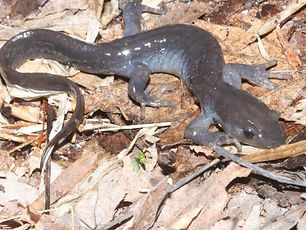
Blue-spotted salamander (Ambystoma laterale), a dark salamander speckled with bluish-white flecks, native to northern Indiana
Blue Spotted Salamander

Ambystoma laterale

4 – 5 ½ inches

Species of Special Concern

Green salamander (Aneides aeneus), a state-endangered species with lichen-green markings, found on rocky cliffs in southern Indiana
Green Salamander

Aneides aeneus

3¼ – 5 inches

Endangered

Longtail salamander (Eurycea longicauda), a slender yellow-orange salamander with a long tail, found near Indiana springs and caves
Longtail Salamander

Eurycea longicauda

4 – 6 inches

Common

Mudpuppy (Necturus maculosus), a large fully aquatic salamander with frilly red external gills, found in Indiana rivers and lakes
Mudpuppy

Necturus maculosus

8 - 14 inches

Unknown, uncommon

Northern slimy salamander (Plethodon glutinosus), a black salamander flecked with silvery-white, found in Indiana woodlands
Northern Slimy Salamander

Plethodon glutinosus

5 – 7 inches

Common

Redback salamander (Plethodon cinereus), a small woodland salamander with a red-orange back stripe, common in Indiana forests
Redback Salamander

Plethodon cinereus

2 ½ – 4 inches

Common

Spotted salamander (Ambystoma maculatum), a black mole salamander with two rows of bright yellow spots, found in Indiana forests
Spotted Salamander

Ambystoma maculatum

4 3/8 - 7 inches

Common

Western lesser siren (Siren intermedia nettingi), an eel-like aquatic salamander with external gills and front legs only, in Indiana wetlands
Western Lesser Siren

Siren intermedia

7 – 27 inches

Uncommon

Cave salamander (Eurycea lucifuga), a bright orange, black-spotted salamander with a long prehensile tail, found in Indiana caves
Cave Salamander

Eurycea lucifuga

4 – 6 inches

Somewhat common

Hellbender (Cryptobranchus alleganiensis), a giant state-endangered aquatic salamander of clean southern Indiana rivers
Hellbender

Cryptobranchus alleganiensis

11 – 25 inches

Endangered

Marbled salamander (Ambystoma opacum), a stocky black salamander with bold white or silver crossbands, found in Indiana
Marbled Salamander

Ambystoma opacum

3 ½ – 4 inches

Common

Northern dusky salamander (Desmognathus fuscus), a brown stream salamander with a pale, keeled tail, found in Indiana
Northern Dusky Salamander

Desmognathus fuscus

2 ½ – 4 inches

Common

Ravine salamander (Plethodon richmondi), a slender dark salamander of forested hillsides and ravines in Indiana
Ravine Salamander

Plethodon richmondi

3 – 4 ½ inches

Common

Smallmouth salamander (Ambystoma texanum), a dark mole salamander with a small head and gray lichen-like flecks, found in Indiana
Smallmouth Salamander

Ambystoma texanum

4 – 5 ½ inches

Common

Streamside salamander (Ambystoma barbouri), a gray-brown mole salamander that breeds in Indiana streams
Streamside Salamander

Ambystoma barbouri

4 – 5 ½ inches

Species of Special Concern

Zigzag salamander (Plethodon dorsalis), a small woodland salamander with a wavy zigzag back stripe, found in southern Indiana
Zigzag Salamander

Plethodon d. dorsalis

2 ½ – 4 inches

Common

Four-toed salamander (Hemidactylium scutatum), a tiny salamander with a white belly marked by black spots, found in Indiana
Four-toed Salamander

Hemidactylium scutatum

2 - 3 ½ inches

Common

Jefferson salamander (Ambystoma jeffersonianum), a slender gray-brown mole salamander with faint bluish flecks, found in Indiana
Jefferson Salamander

Ambystoma jeffersonianum

6 - 8 inches

Common

Mole salamander (Ambystoma talpoideum), a stocky, big-headed state-endangered salamander recently confirmed in Indiana
Mole Salamander

Ambystoma talpoideum

3 – 3 ½ inches

Endangered

Northern red salamander (Pseudotriton ruber), a bright red-orange, black-spotted state-endangered Indiana salamander
Northern Red Salamander

Pseudotriton ruber

4 – 5 ½ inches

Endangered

Red-spotted newt (Notophthalmus viridescens), an olive newt with red spots; its juvenile eft stage is bright orange, found in Indiana
Red-spotted Newt

Notophthalmus viridescens

3 – 4 inches

Common

Southern two-lined salamander (Eurycea cirrigera), a yellow salamander with two dark back stripes, found near Indiana streams
Southern Two-lined Salamander

Eurycea cirrigera

2 ½ – 3 ¼ inches

Common

Tiger salamander (Ambystoma tigrinum), a large dark salamander with yellow blotches - Indiana's largest land salamander
Tiger Salamander

Ambystoma tigrinum

7 – 9 inches

Common

bottom of page